The NHS gets about 38M visits a month from Google in the UK, and some of its biggest wins are plain tools and charts, like the BMI calculator that ranks first for "bmi calculator".
The NHS is the UK's free health service. Its website has a page for nearly every illness and medicine, and its hospitals and GP surgeries run sites of their own.
We ran it through our whole SEO toolkit to see what wins, and where the NHS gets in its own way.
Here are 9 lessons you can copy, plus the part you can't.
Build the tools people search for
We started with our Organic Traffic Checker. It estimates a site's organic traffic, meaning the people who find it on Google without ads.
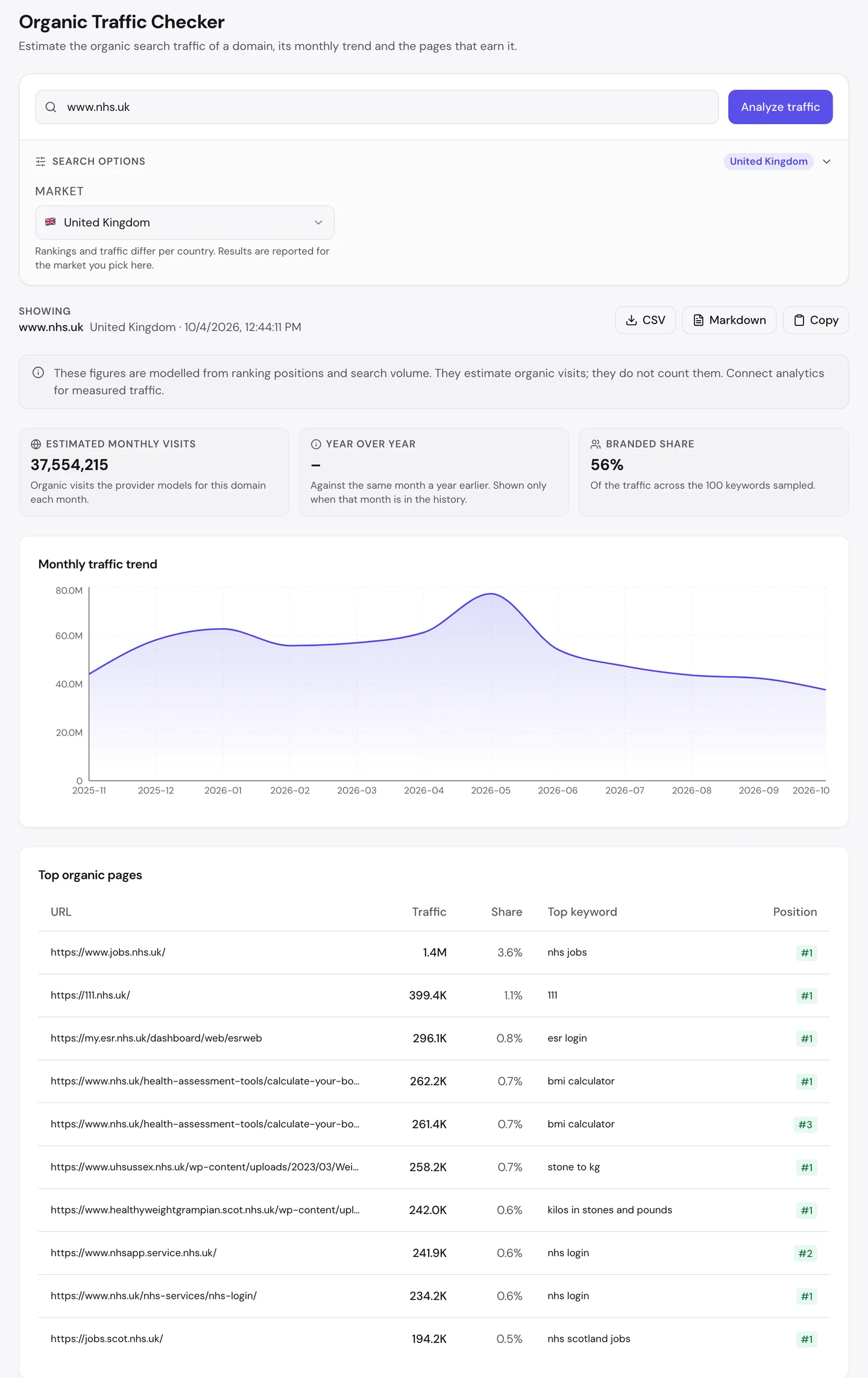
That's about 38M visits a month in the UK. The trend peaked in May and has dropped by about half since.
The tool reads the whole nhs.uk family, not just the main site. So the top page is NHS Jobs, with about 1.4M visits, and 111, the service for urgent help, comes next.
Now look further down. The BMI calculator, a tool that checks if your weight is healthy, ranks first for "bmi calculator".
Then come 2 PDFs from hospitals. A weight chart from Sussex ranks first for "stone to kg", and a chart from Grampian in Scotland ranks first for "kilos in stones and pounds".
The Sussex chart gets about 260K visits a month, and the Grampian one about 240K. Both are plain PDFs, not web pages.
They just do a sum you'd rather not do in your head. That's a job people search for every day.
In the searches we sampled, 56% of the traffic came from people typing the name NHS. The rest found it the way you might, by searching for what they needed.
The Traffic tab of our Website Audit shows the whole world.
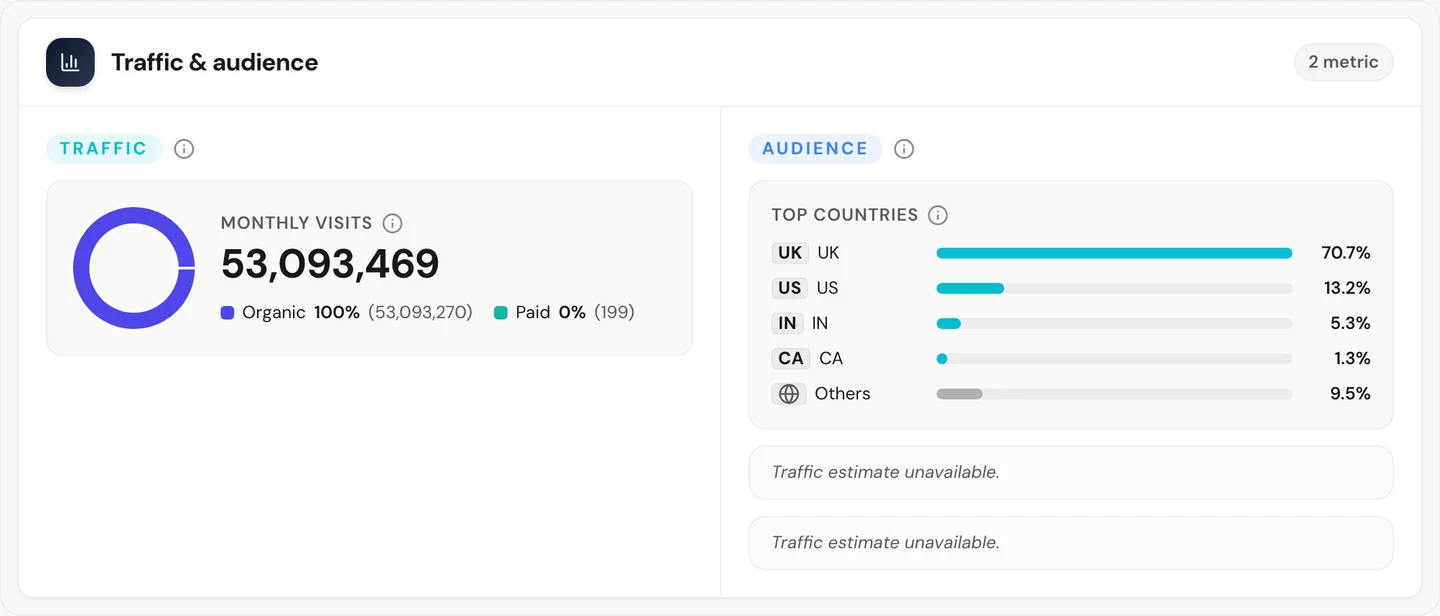
Worldwide it's about 53M search visits a month. About 7 in 10 of them come from the UK.
Calculator.net, which we studied too, is built almost entirely on small tools like these.
So find the sums and charts your readers need, and give each one a simple page of its own. Our Organic Traffic Checker shows which of your pages pull in visits.
Name each page after the medicine
The Keywords tab of our audit lists the searches a site ranks for, where it ranks and how many visits each one sends. This tab looks at the US.
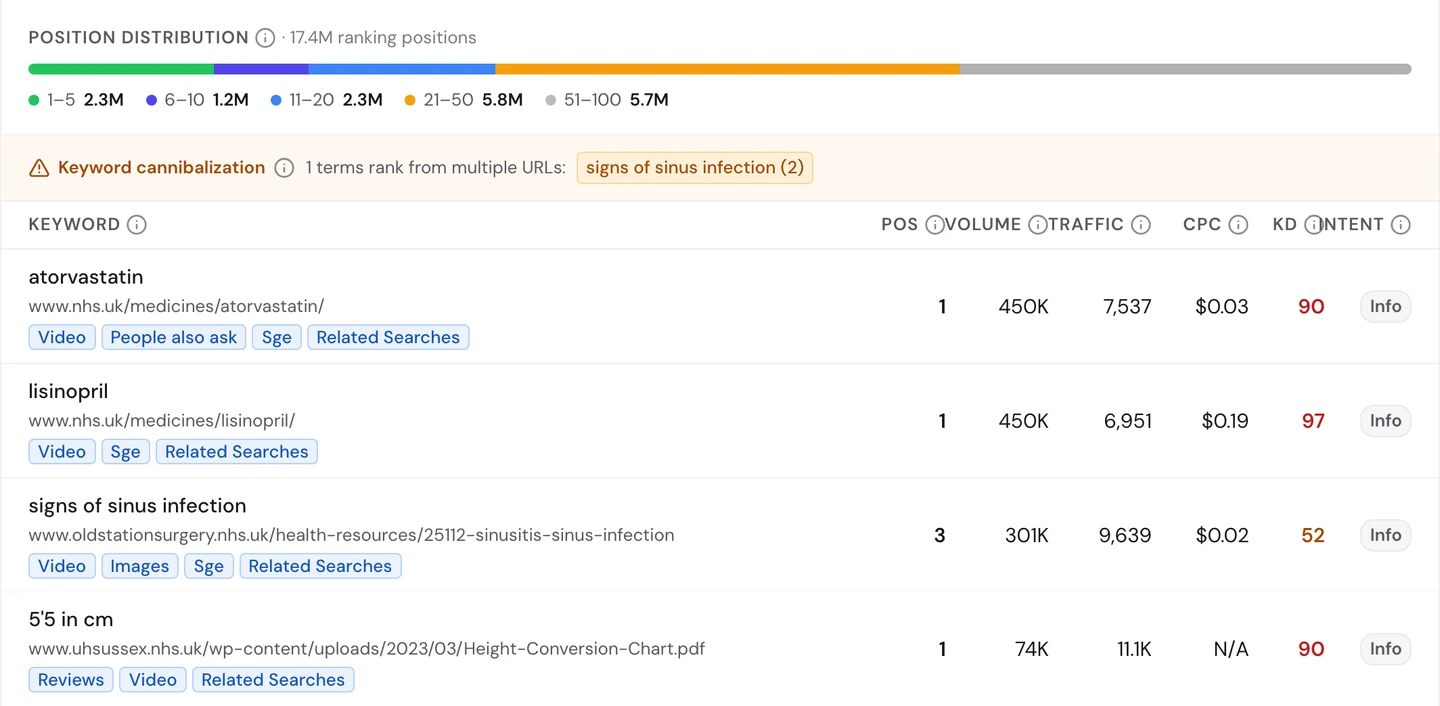
In the US, the NHS ranks first for "atorvastatin" and "lisinopril", 2 common pills. Each one is searched about 450K times a month.
It does the same for "gabapentin" and "amlodipine". And the US isn't even the country the NHS serves.
Here's what you see when you open one of its medicine pages.
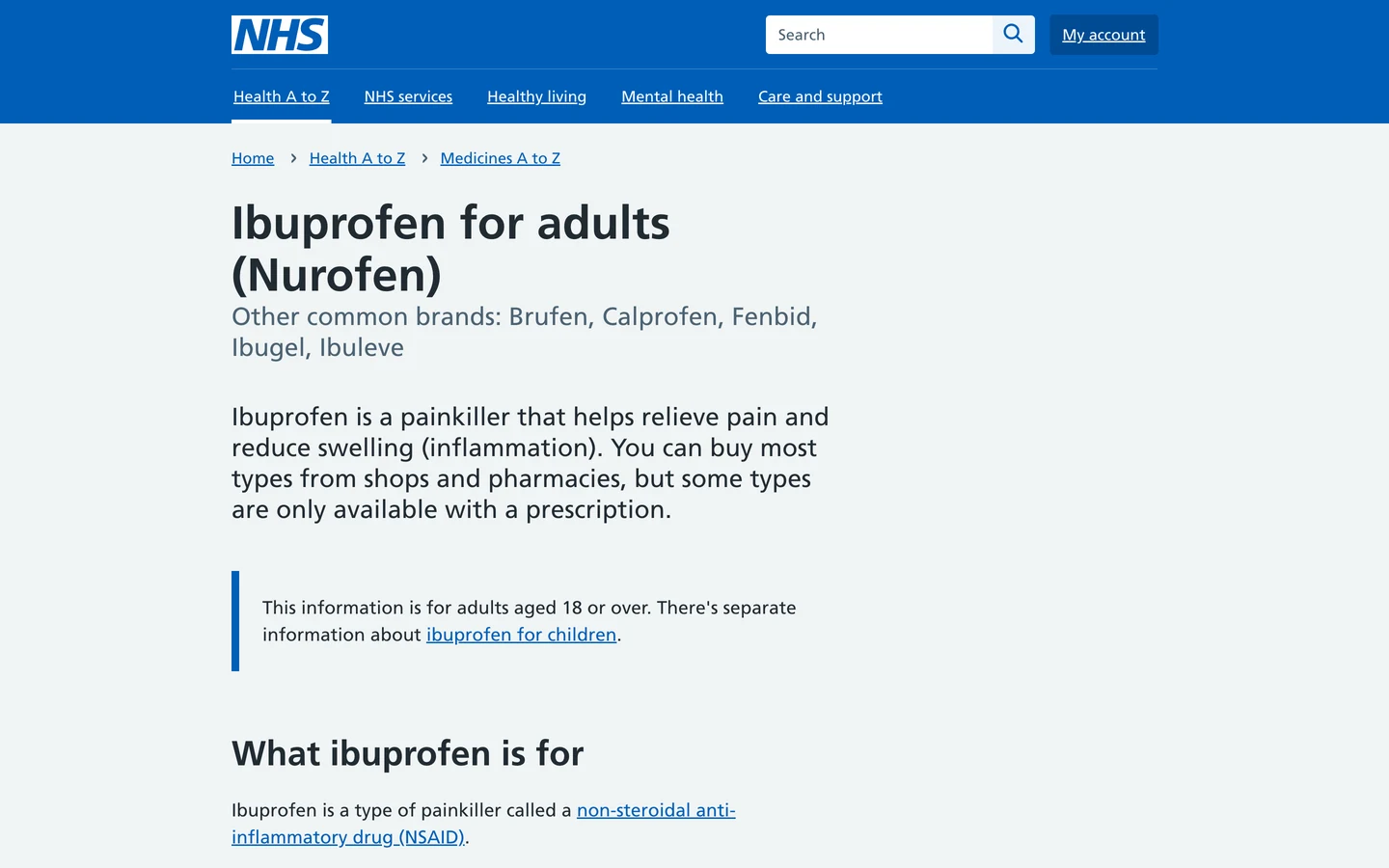
The main heading is just the medicine's name, with the best-known brand after it. The other brand names come next, so people who search for those find the page too.
Then the first line says what it is in plain words: a painkiller that also brings down swelling.
The address is plain too, /medicines/ibuprofen-for-adults/. You know what's on the page before you open it.
Docker Hub, which we studied too, wins the same way, with pages named after the software people want.
So name each page after the exact word people type, and say what it is in the first line. Find those words with our Keyword Research tool.
Pick one main copy of each page
Look back at the warning above the keyword rows. It's keyword cannibalization, when your own pages compete for the same search.
The search is "signs of sinus infection". In the rows we saw, it goes to GP surgery websites, not to the main NHS site.
Old Station Surgery and 2 surgeries in Wales all publish the same sinus article. They all rank for sinus searches, and they push against each other.
The audit's Competitors tab shows the same thing from a different side.
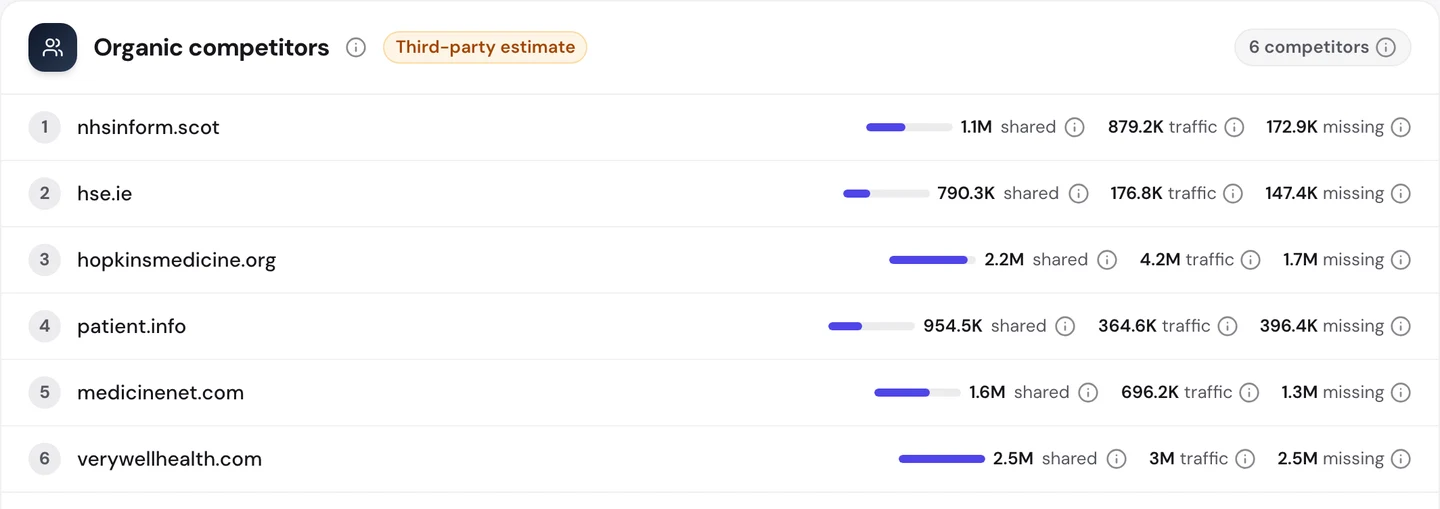
You might expect a big US health site at the top. Instead, the closest rival is nhsinform.scot, a health site for Scotland's NHS.
Next comes hse.ie, Ireland's health service.
That means the NHS's first fight is with its own family and its neighbours. They write about the same illnesses, and some even share the same articles.
Inside nhs.uk, the audit's Technical SEO tab finds the same problem on a small scale.
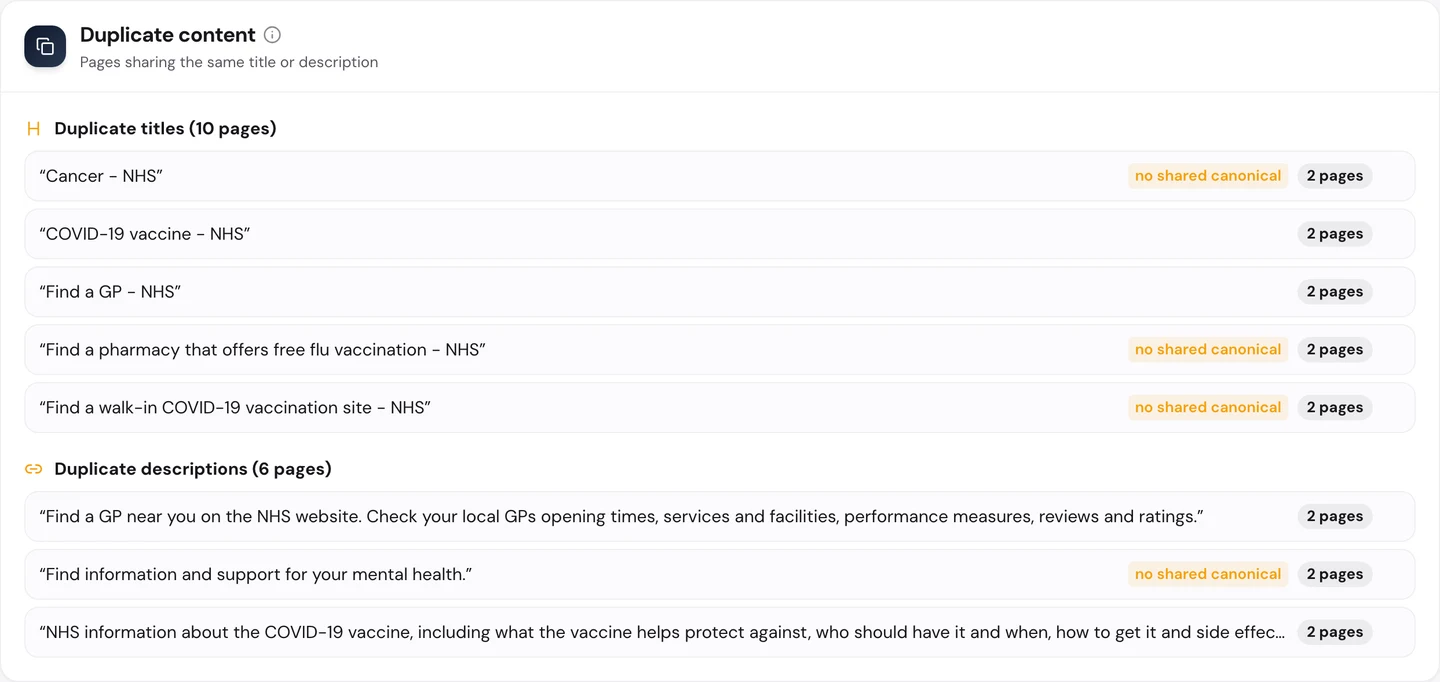
5 titles show up on 2 pages each, like "Cancer - NHS". For 3 of them, the pages don't say which copy is the main one.
The fix is a canonical tag, a tag that tells Google which copy is the main one. Then Google knows which page to show you.
So pick one main page for each topic, and point every copy at it with a canonical tag. Then watch which page ranks with our Rank Tracker.
Keep titles short enough to show
Our free browser extension checks one page at a time. Open a page, click the seotools.pro icon, and a panel opens beside it with 33 SEO checks.
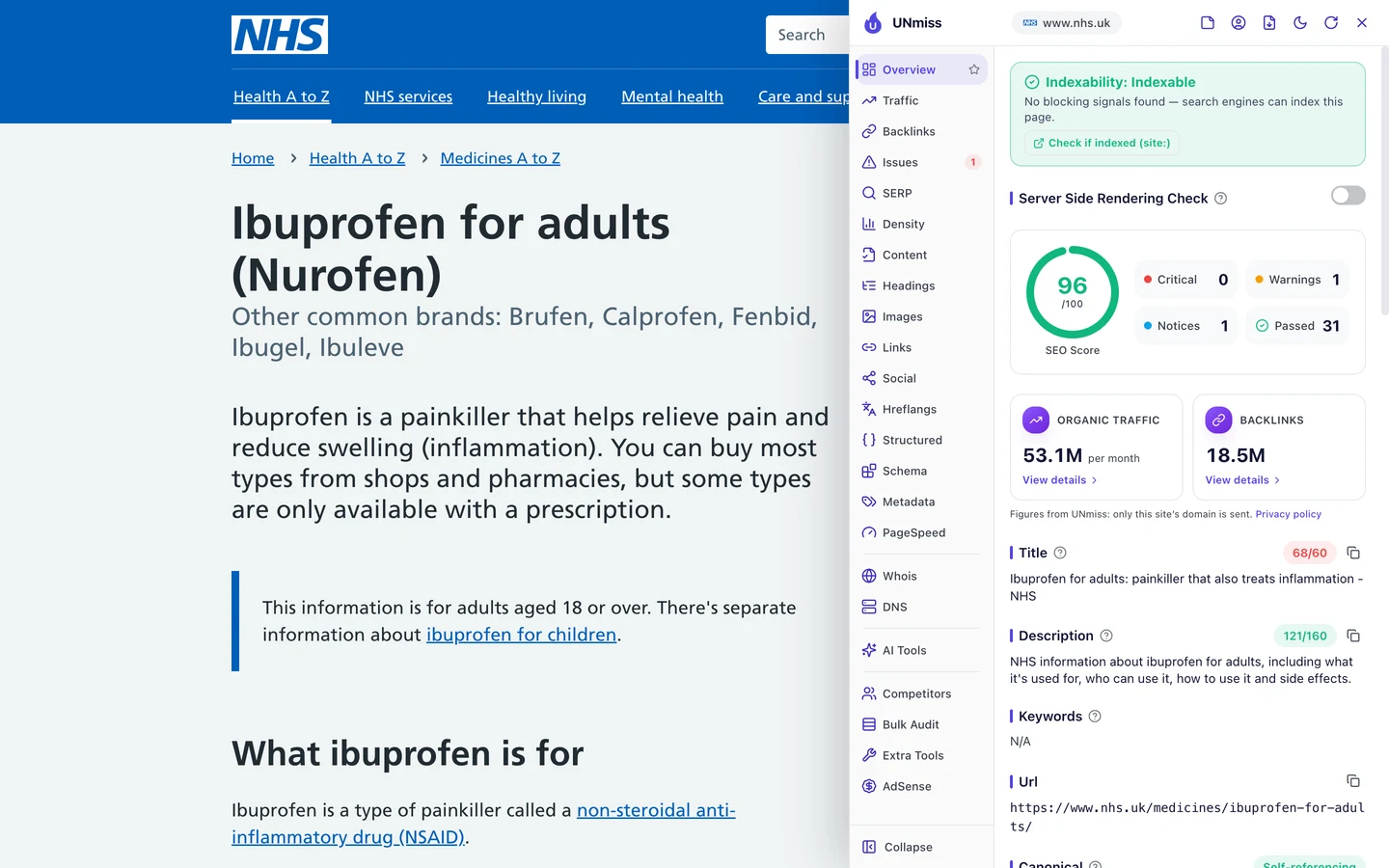
The ibuprofen page scores 96 out of 100. Its only warning is the title, the blue line Google shows for each result.
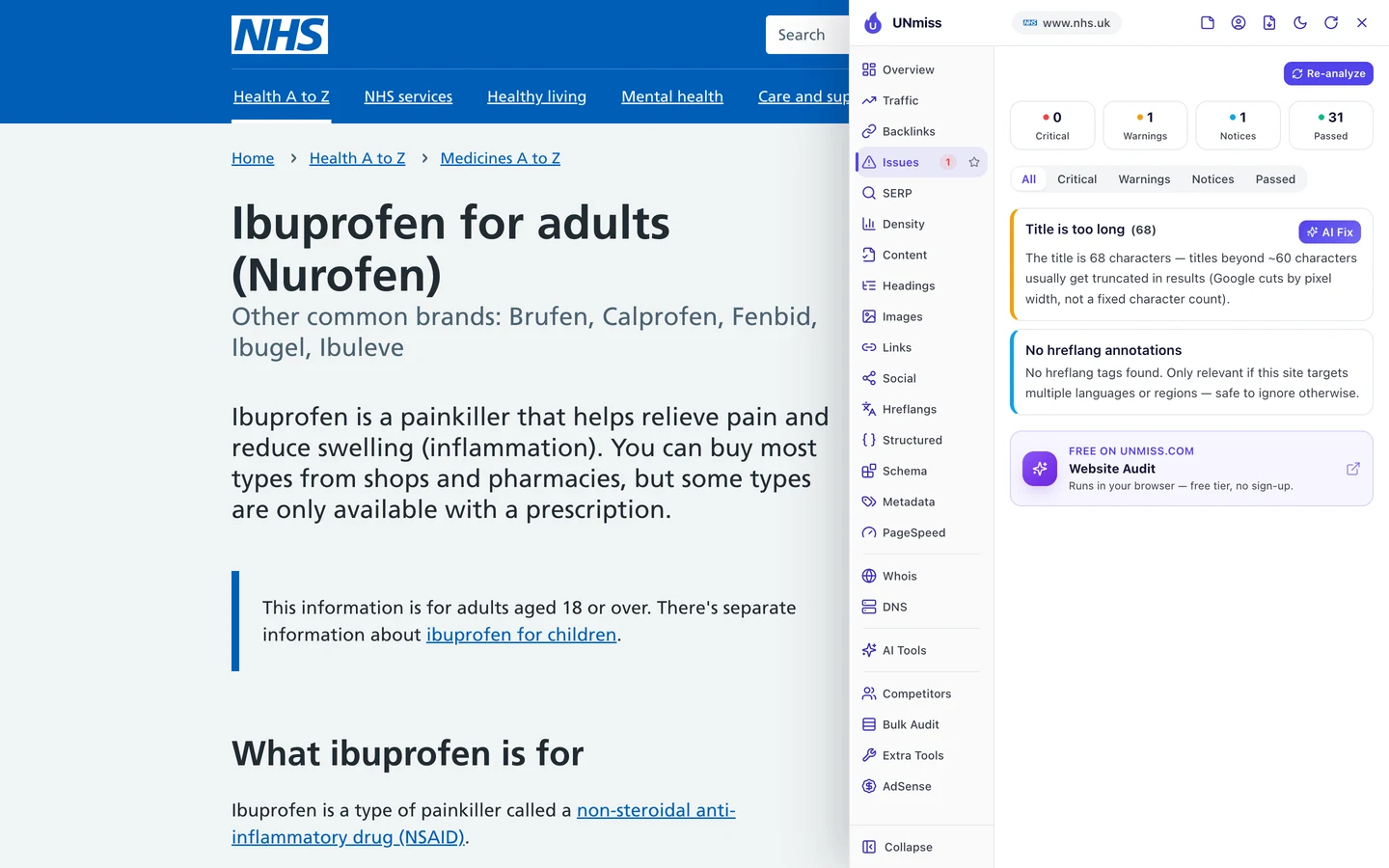
It's 68 characters long, and Google usually cuts titles after about 60. The end of it may never show.
The UTI page gets its title right. UTIs are infections of the bladder and the parts around it.
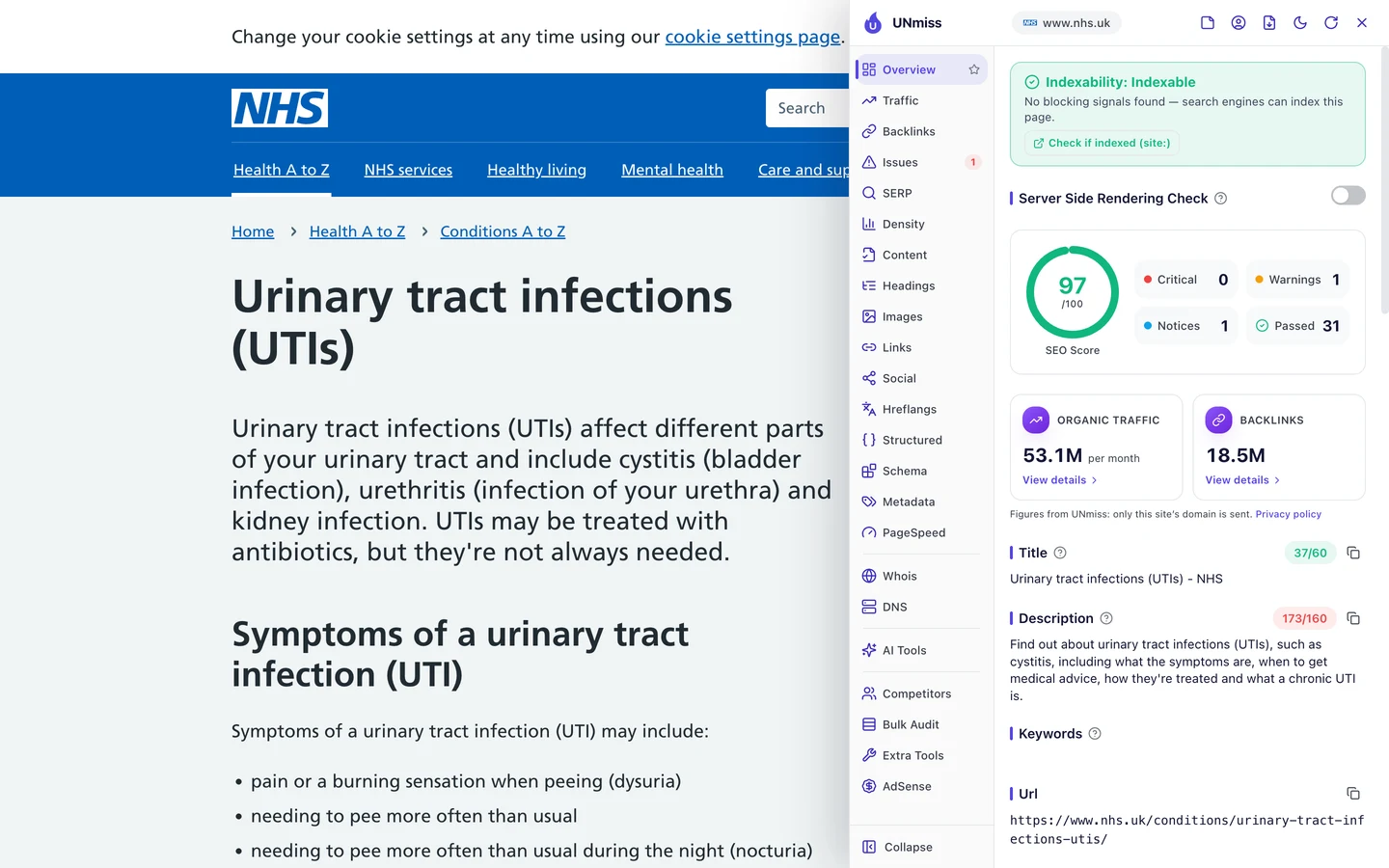
Its title is just 37 characters. But this time the description, the short summary Google may show under your title, is too long.
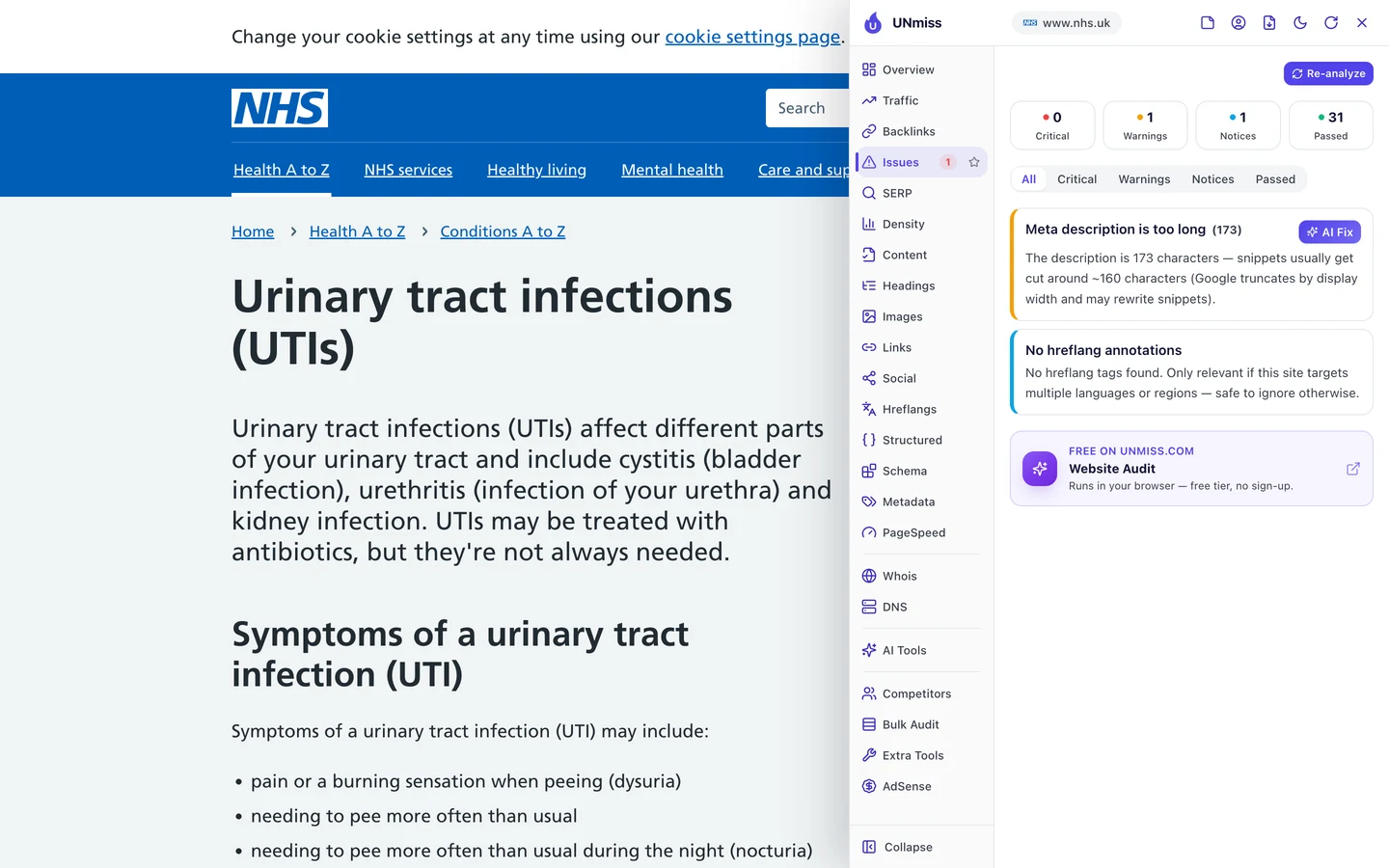
It runs to 173 characters, and Google usually shows about 160. Both pages are good, but each one loses a few words at the end.
So keep titles under about 60 characters and descriptions under about 160. Our Meta Tag Generator shows how long yours should be.
Mark up each page in code
Structured data is code that tells Google what a page is. The extension's Structured tab looks for it.
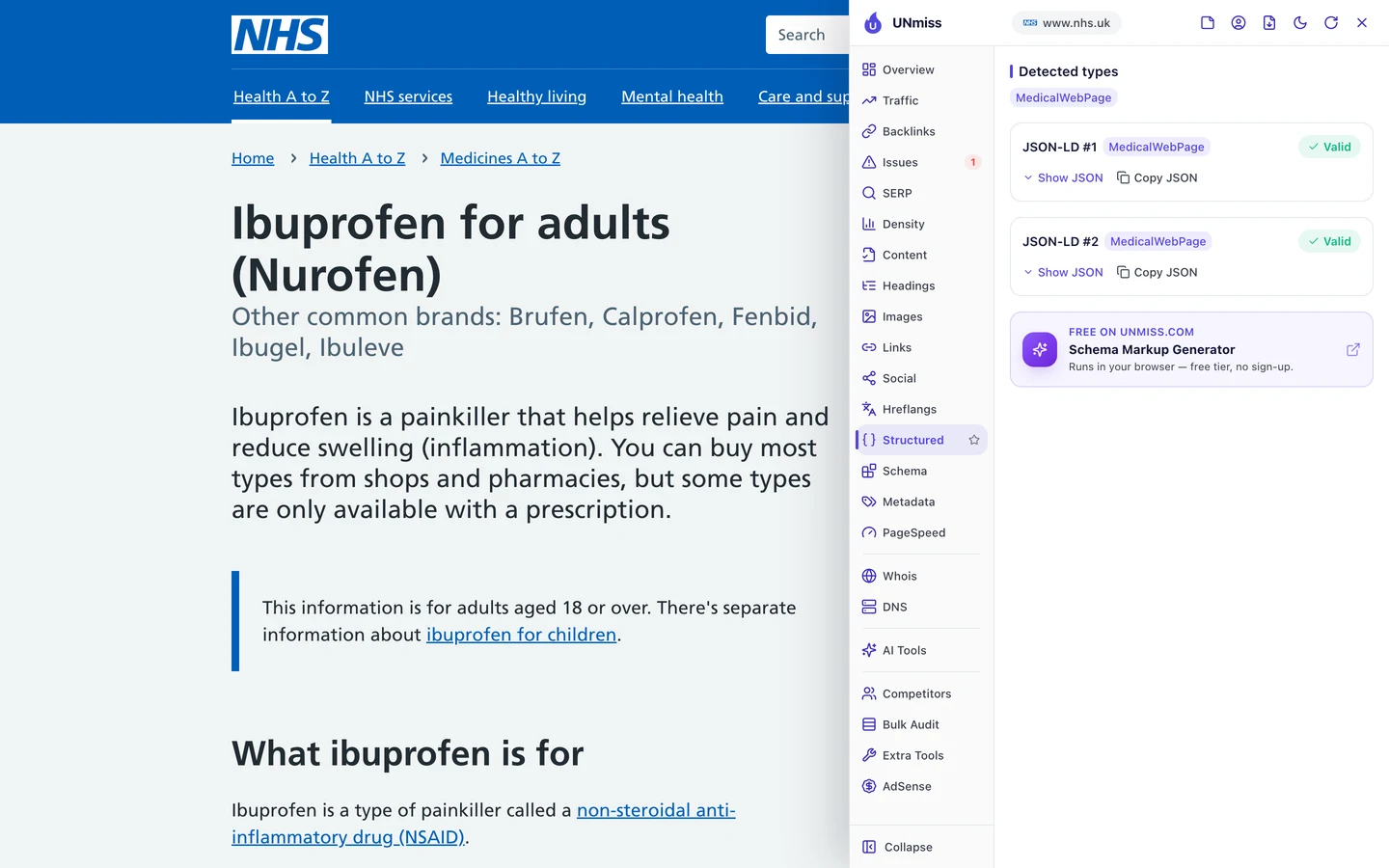
The ibuprofen page has 2 blocks of it, and both say the same thing: this is a medical web page. Both are valid, so Google can read them.
The audit found the same code on most pages it checked. Of 50 pages, 46 have structured data, and 38 use the medical type.
Here's the UTI page.
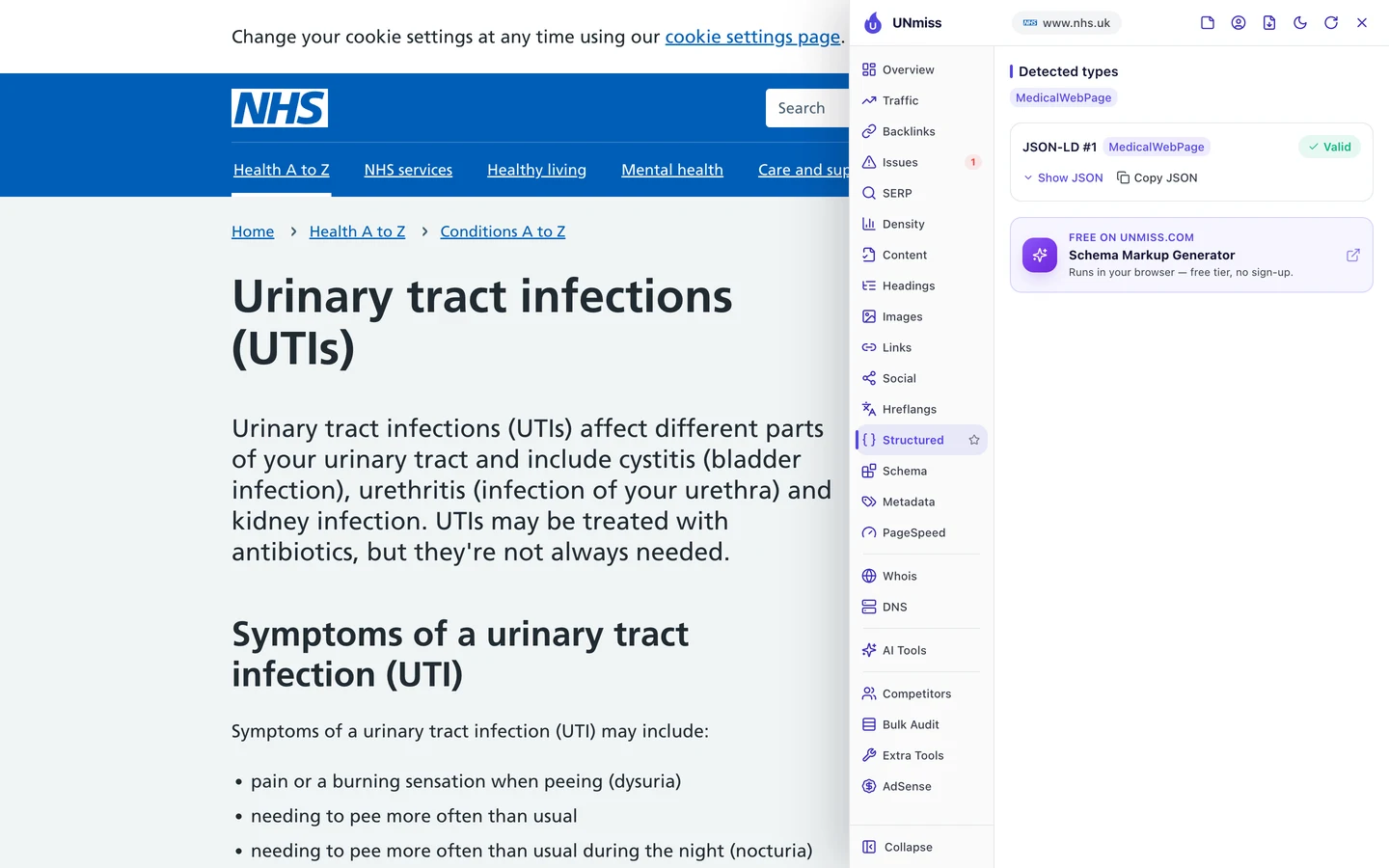
It has a valid block of medical code too. That's the right type for a health page.
The Content tab shows what's still missing.
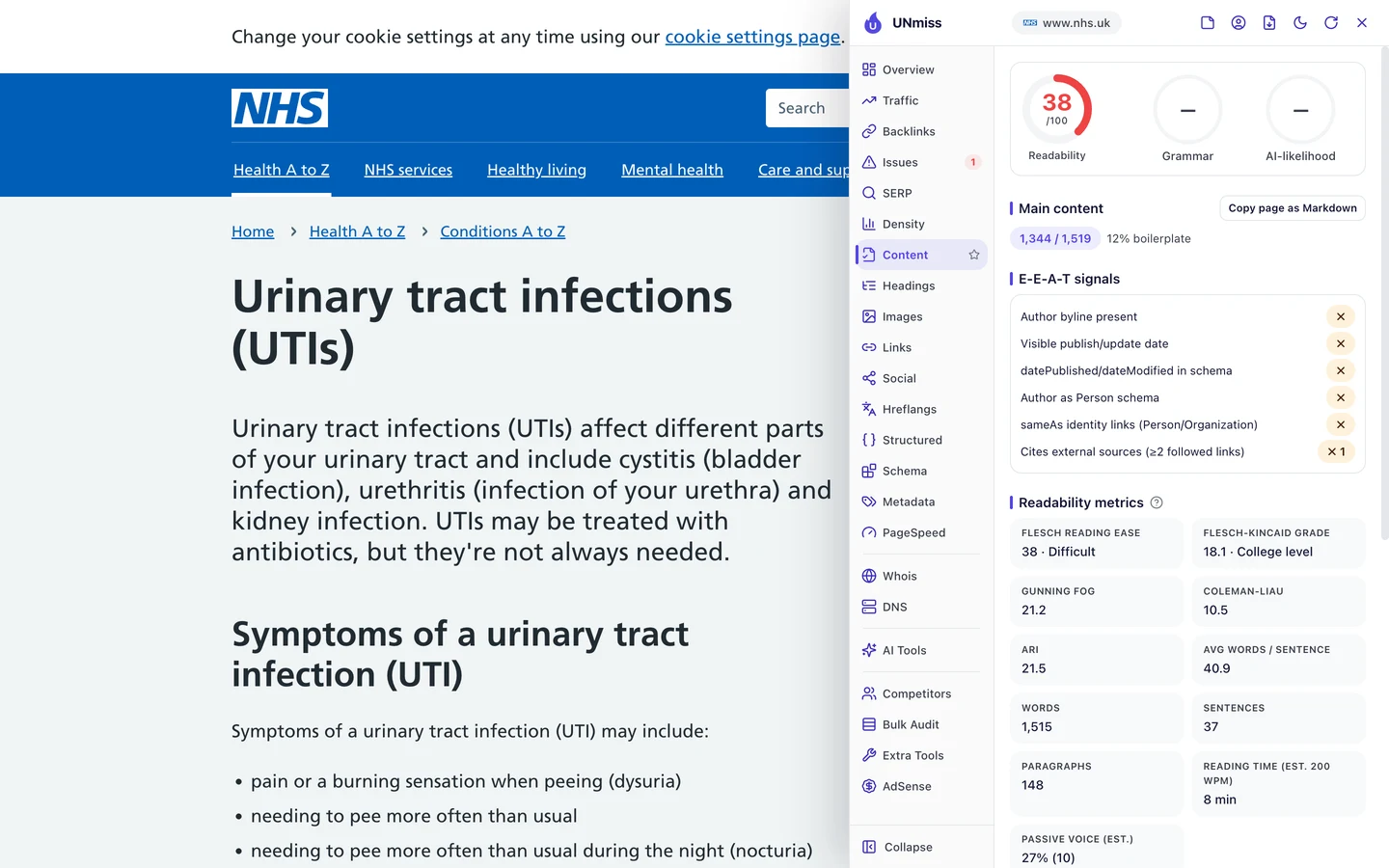
The extension finds no author name and no date in the code. The page does say when it was last checked, at the bottom, but only as plain text.
It also rates the text hard to read, 38 out of 100. Look closer, though: most of the "long sentences" it lists are bullet lists with no full stops.
The real text is short and plain. It's only the tool's count that makes it look hard.
Health pages need your trust more than most. Healthline, a health site we studied too, gets its visits from millions of small health questions.
So add code that says what each page is, who checked it and when. Our Schema Markup Generator writes it for you.
Earn links by being the source
A backlink is a link from another website to yours. Google treats each one a bit like a vote of trust.
The Backlinks tab of our audit shows the same data as our Backlink Analyzer.
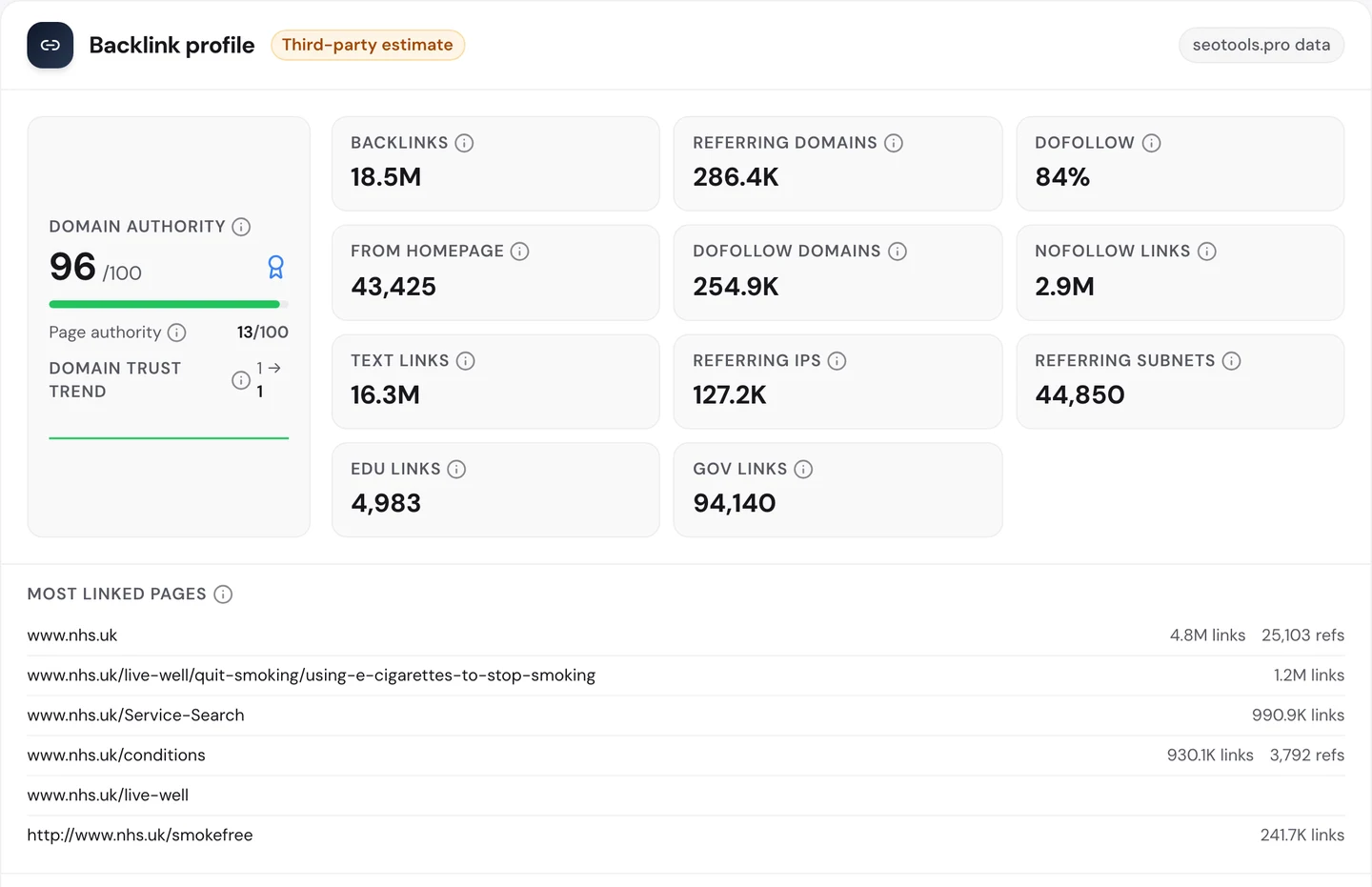
The NHS has about 18.5M links from about 286K websites that link to it. Its Domain Authority, our 0 to 100 score for a site's link strength, is 96.
Look at who links to it, and you'll see why. About 94K links come from government sites, and about 5K from college sites.
After the homepage, the most linked page explains how to use e-cigarettes to quit smoking. It has about 1.2M links of its own.
When you're the official source, other sites link to you without being asked. They want to show their readers where the facts come from.
Our Domain Overview shows what all that trust earns in the US.
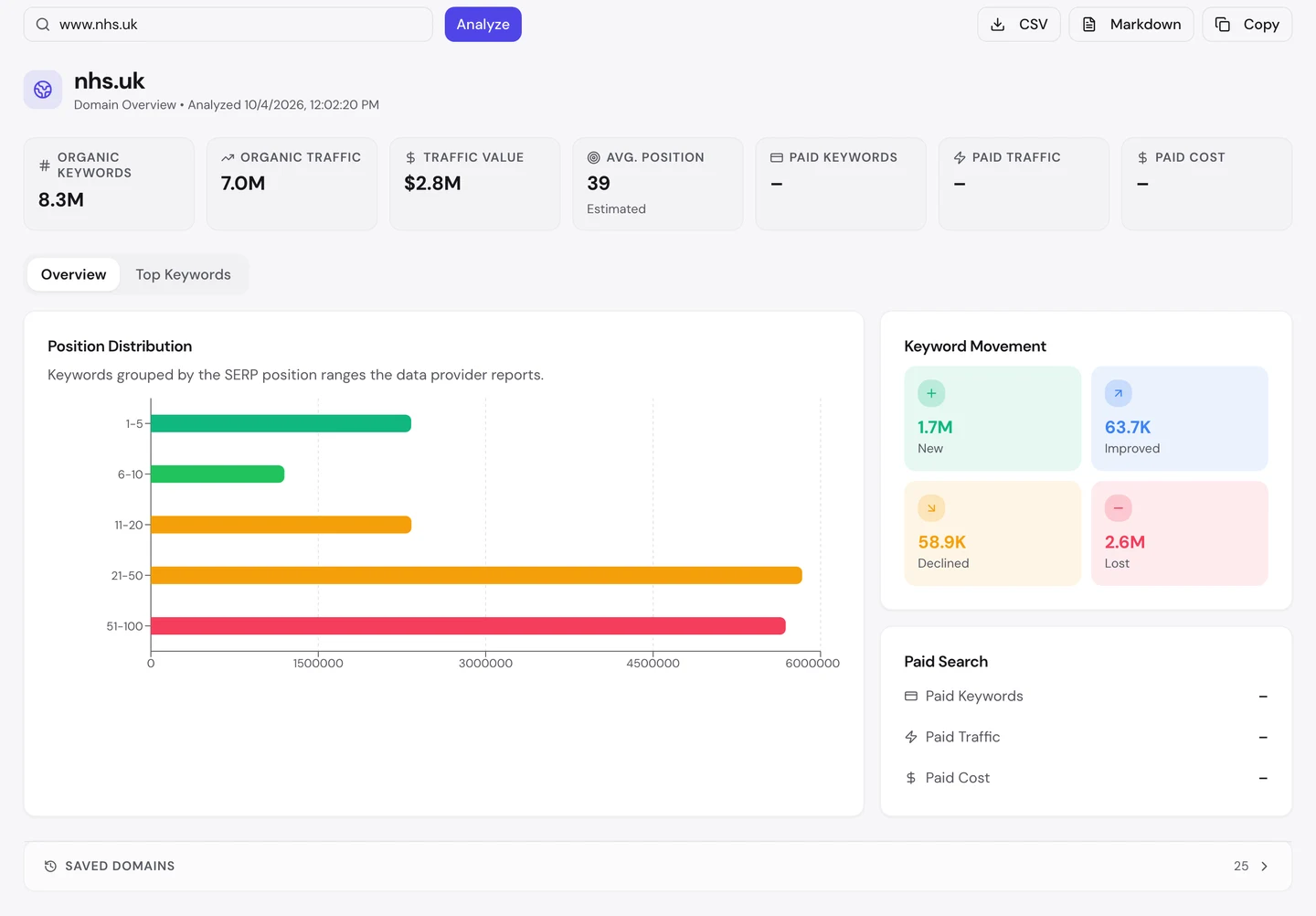
The NHS gets about 7M visits a month in the US, a country it doesn't serve. The traffic value, what those visits would cost as Google ads, is about $2.8M.
It ranks for about 8.3M searches there. But its average position is 39, on page 4 of Google, and it lost more searches than it gained.
So write the page others in your field will want to quote, like a clear guide or a handy chart. Then see who links to it with our Backlink Analyzer.
Audit your sitemap and redirects
We checked nhs.uk with our Website Audit, and gave it the sitemap, the file that lists a site's pages for Google. The audit sends a crawler, a program that visits pages the way Google does.
It opens each page and follows the links to the next ones. It checked 250 pages, and the NHS scored 88 out of 100, which the report rates as good.
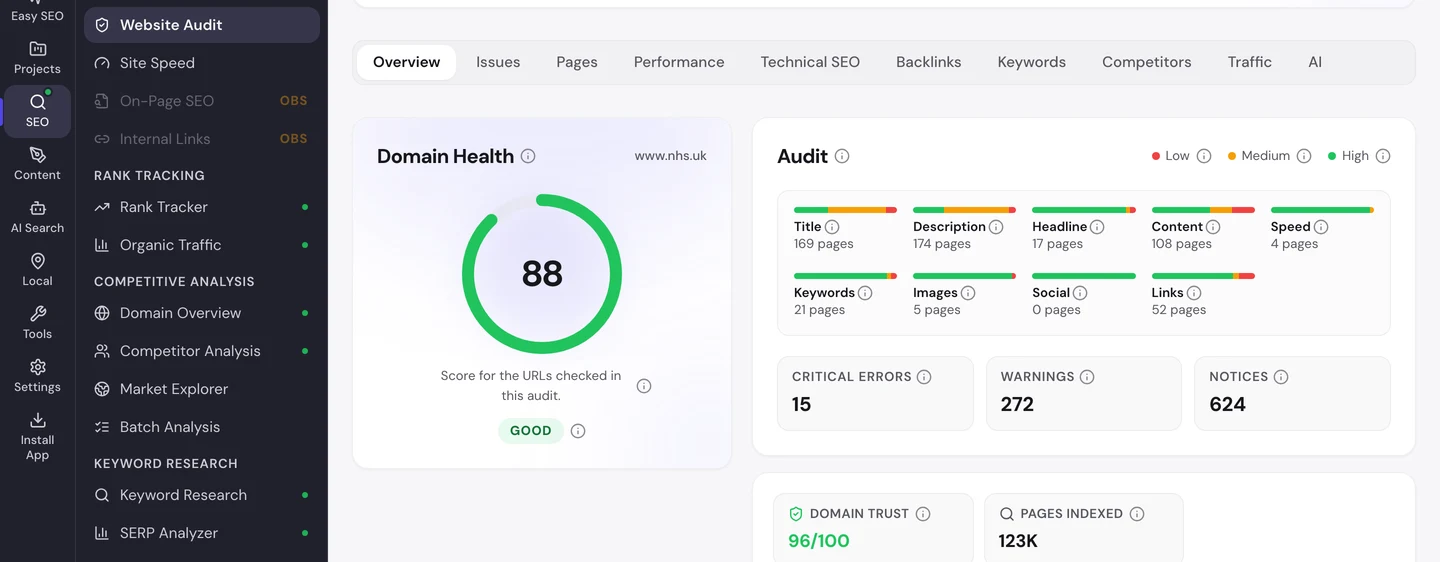
Google has about 123K NHS pages listed, so our crawl is a small sample. The Issues tab sorts what it found by how much it matters to you.
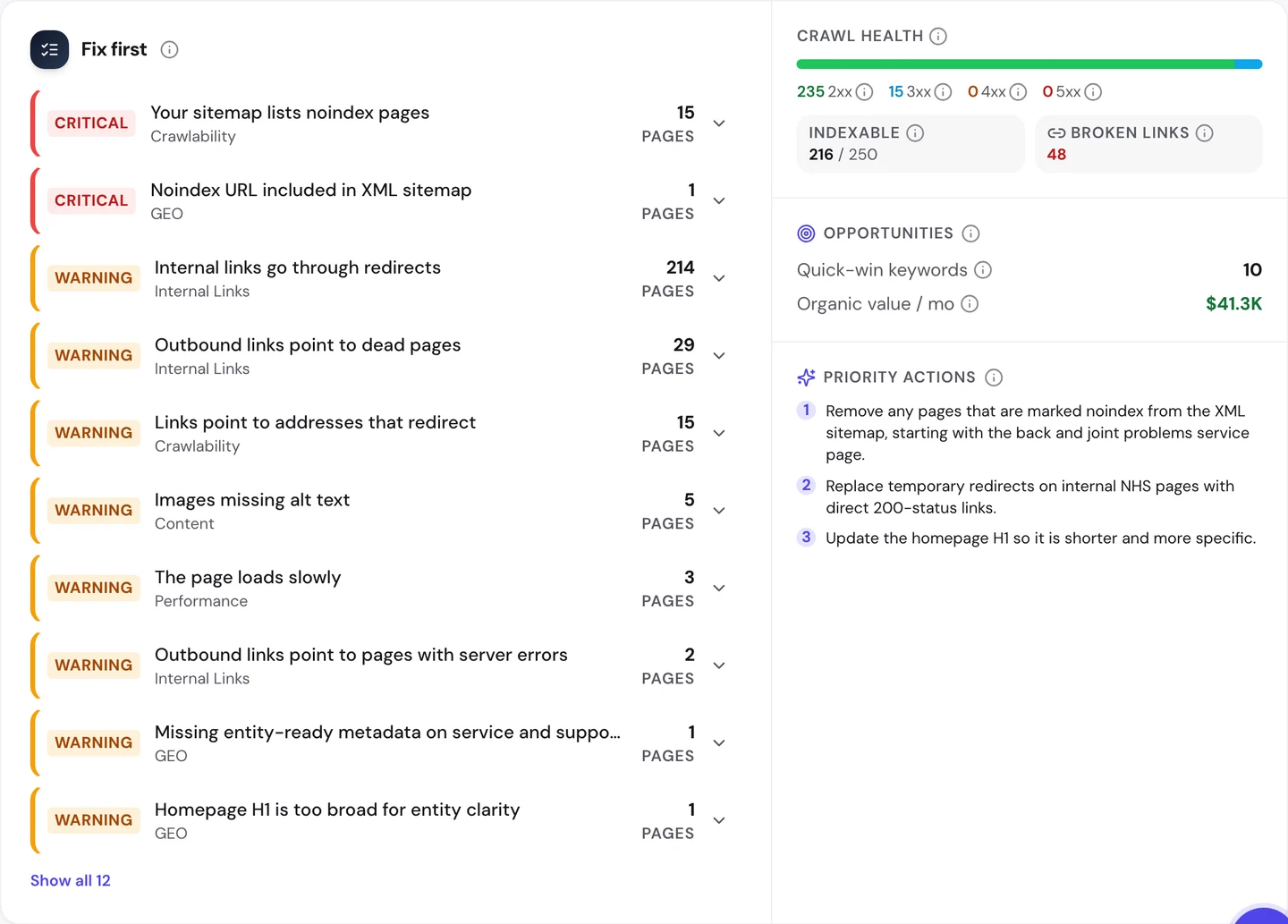
Every critical error is about the sitemap. It lists 15 pages that are marked noindex, a tag that tells Google not to list a page.
That means the sitemap says "please visit these" while the pages say "don't show me". Google gets 2 signals that clash.
The biggest warning covers far more pages. On 214 pages, links go through redirects, which send you from an old address to a new one.
Each redirect adds an extra trip for you and for Google. And 29 pages link out to pages on other sites that are dead.
The Technical SEO tab shows which pages Google may list.
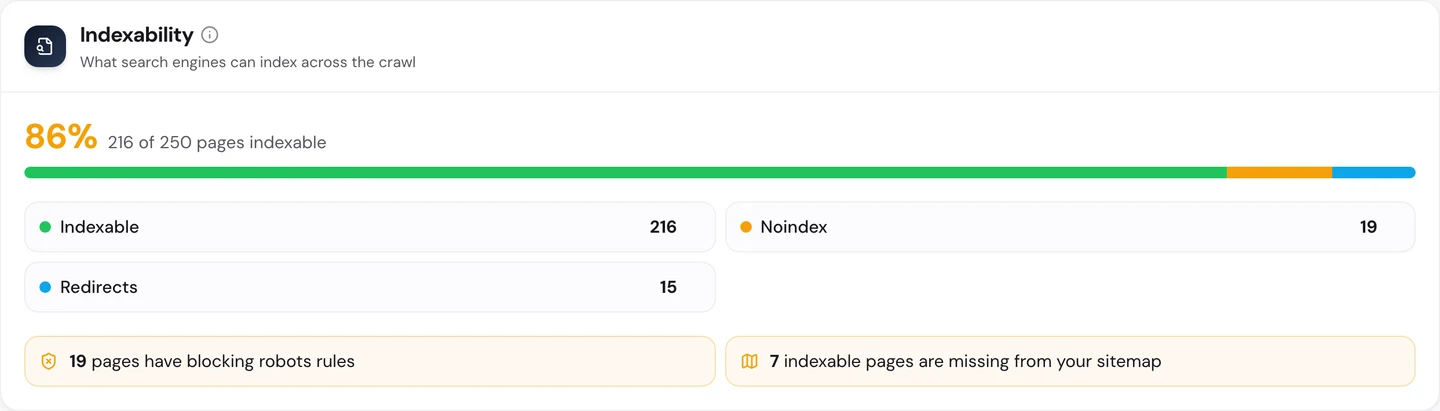
About 6 in 7 crawled pages can be listed. But 7 pages that could be listed are missing from the sitemap.
The sitemap has pages it shouldn't, and misses pages it should.
You don't have to work out what to fix first. The audit's AI tab writes the plan: a short summary, each problem with how to fix it, and a 90-day to-do list.
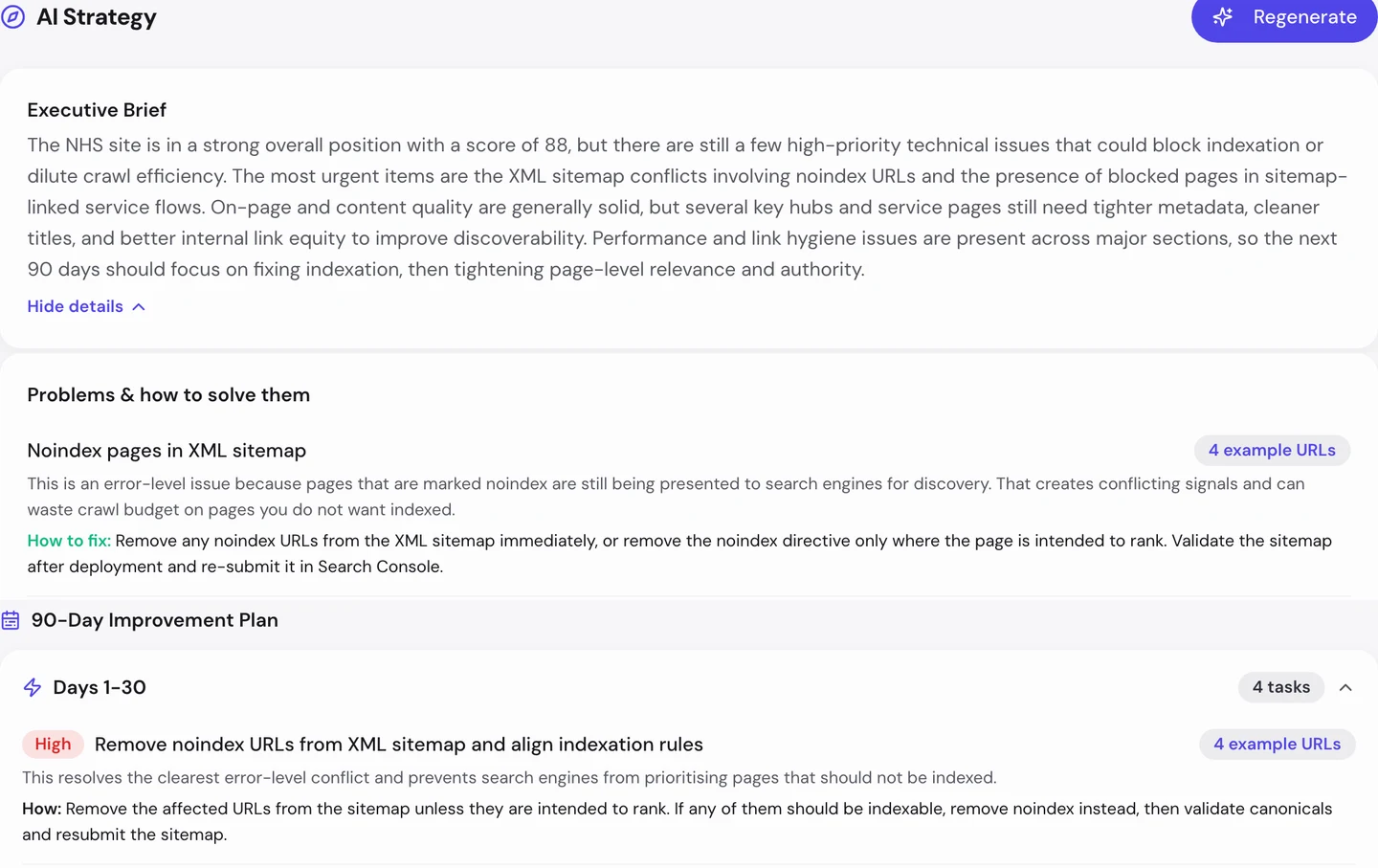
For the NHS, the first month goes to the sitemap. Then come the pages blocked from Google and the links that go through redirects.
So make your sitemap list only the pages you want Google to show, and point every link straight at the final address. Our Website Audit finds both.
The NHS sitemap asks Google to visit pages that also tell Google to stay away, and its sister sites publish the same articles. We find mixed signals like these across your sites and fix them, so Google knows which page to show.
- We clean your sitemap so it lists only pages you want shown
- We pick one main page for each topic and set the canonical tags
- We replace links that go through redirects
- SEO and GEO, so AI answers can quote you too
Stop pages jumping as they load
The Performance tab of the audit shows Core Web Vitals. These are Google's 3 checks of how fast a page loads, how fast it reacts and whether it stays still, measured on real visitors' devices.
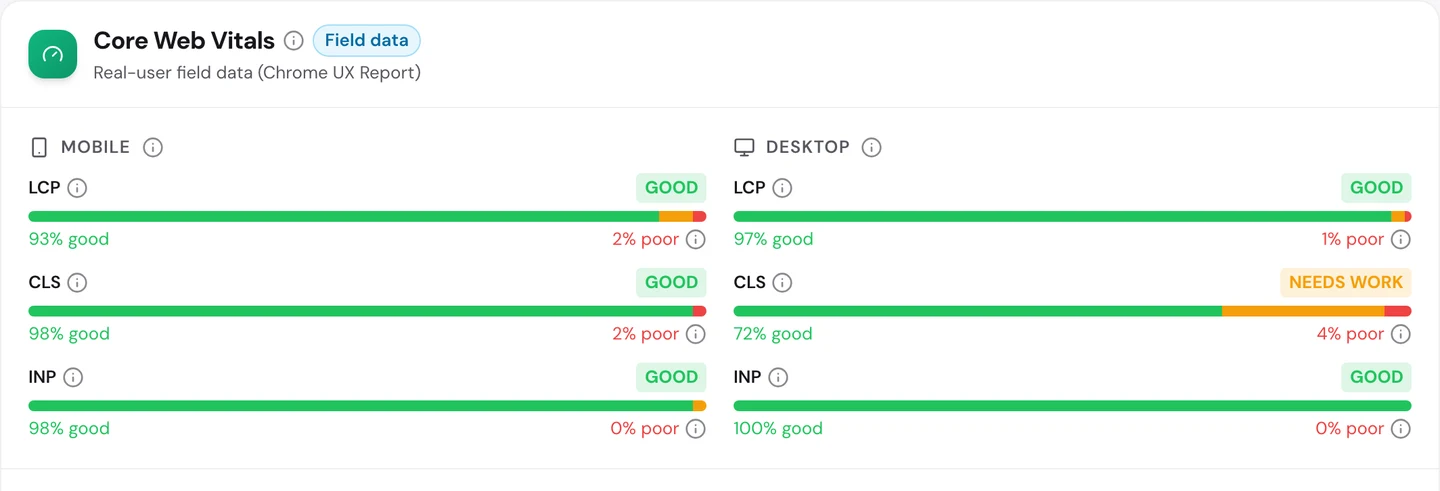
The NHS passes 5 of the 6 checks. On phones, it passes all 3.
The one it fails is whether the page stays still on computers. Only about 7 in 10 computer visits see a steady page.
The audit flags the homepage too. Its notes say content jumps around in a lab test, and the JavaScript files aren't cached.
A page that jumps makes you click the wrong thing. That's the last thing you want on a health site, when you just need the answer.
So save space for images and banners before they load, so nothing pushes the text down. Our Site Speed tool shows what slows each page down.
Let AI tools read your pages
More and more people ask ChatGPT or Claude about their health, instead of searching Google. So we checked which AI tools may read nhs.uk.
The rules for crawlers live in robots.txt, a file that tells crawlers what they may read. Our extension reads it for you.
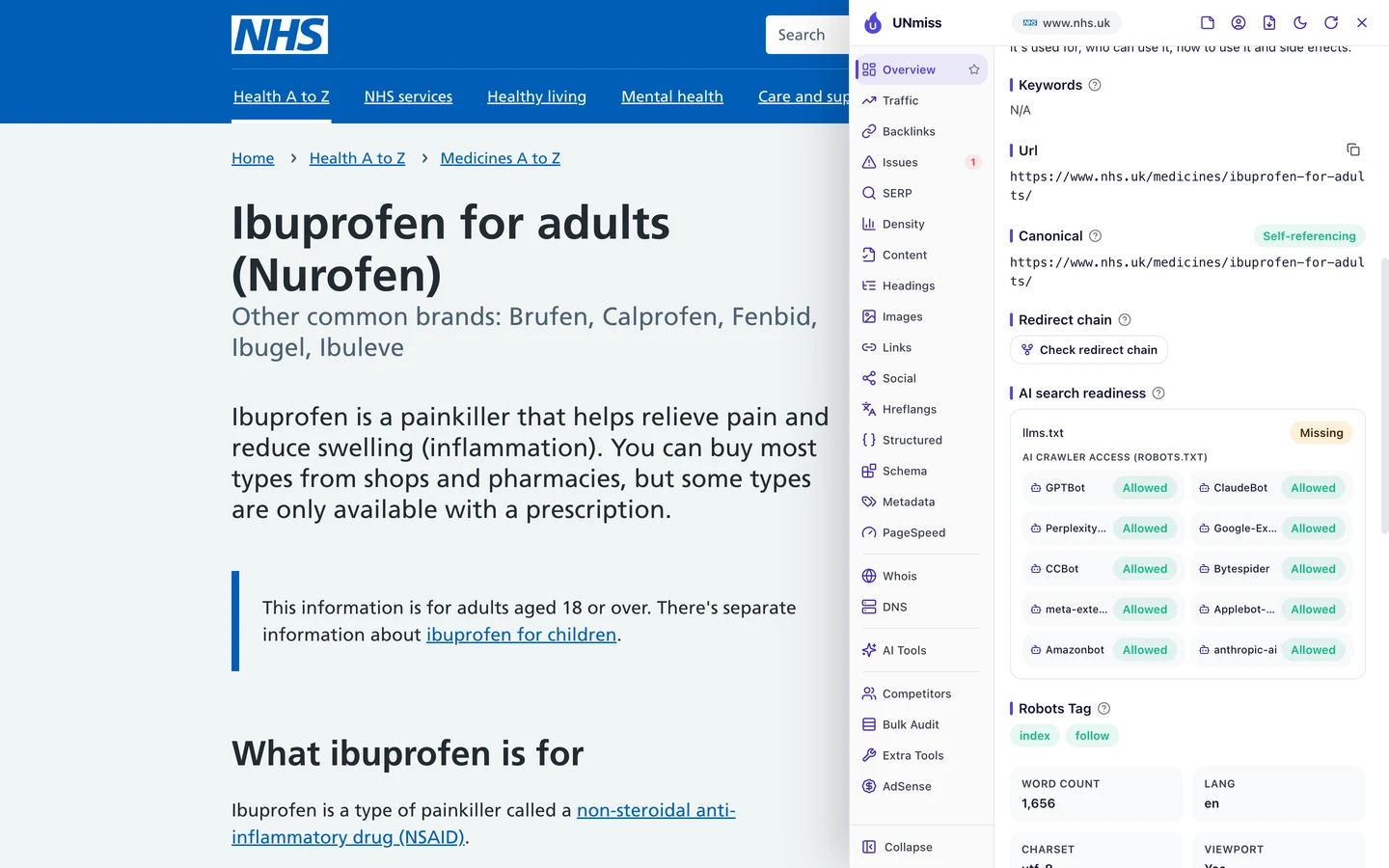
The NHS lets in all 10 AI crawlers the extension checks. But it doesn't have an llms.txt file, a short guide that explains a site to AI tools.
The audit's AI Search card checks a few more crawlers and gives a score.
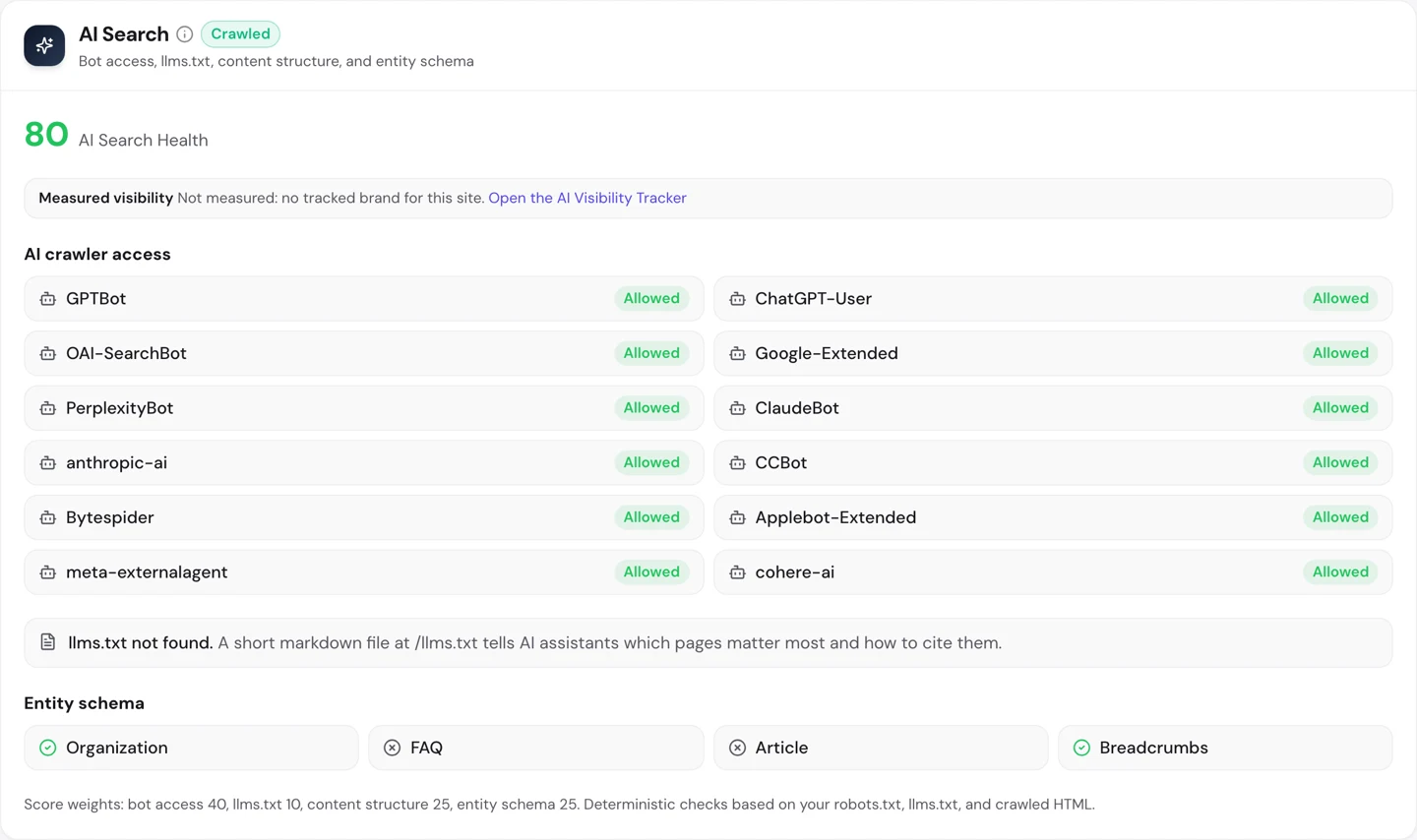
All 12 are allowed, and the AI Search Health score is 80. It loses points for the missing llms.txt, and for missing code that marks up questions and articles.
That open door suits a public health service. Its advice can reach you wherever you ask.
Most sites aren't so open. Our survey of AI crawler rules found that every publisher we checked blocks them, while most software firms let them in.
Our llms.txt survey found the file mostly on software sites. MDN, which we studied too, lets every AI crawler in, just like the NHS.
So decide on purpose who may read your pages, and add an llms.txt file if you want AI tools to find your best ones. Write your rules with our robots.txt generator, then check whether AI tools mention you with our AI Visibility Checker.
A hospital's simple weight chart ranks first in the UK for "stone to kg". Our Organic Traffic Checker shows your top pages and the search behind each one, so you can spot your own quiet winners.
- The same report that measured the NHS
- Pick the country you want to check
- Run it on any rival's domain too
What you cannot copy
First, the part you can't copy: the NHS is the health service for a whole country. More than half its sampled search traffic comes from people typing its name.
It also has many hospital and GP sites under the same name, and sites everywhere link to it. That takes years and a nation's trust to build.
Now a few honest notes on the numbers.
Update the publish/updated date to on or after 4 Oct 2026. The 38M figure is for the UK, and it counts the whole nhs.uk family, not just the main site.
That family takes in NHS Jobs, 111, hospital groups, GP surgeries and the NHS sites for Scotland and Wales. The tool reads the root domain, so they all count.
The Domain Overview and the audit's Keywords tab look at the US. The 53M worldwide figure comes from the audit's Traffic tab.
All of these are estimates. Nobody outside the NHS can count its real visits, so tools work them out from rankings and search volume.
The UK trend also fell by about half since May. Estimates like this can swing when rankings move, so treat the trend as a rough guide.
Our crawl checked 250 pages, a small sample of a very big site. So we used it to find problems that repeat, not to count every error.
The one number to take away
260K.
That's about how many UK visits a month go to one hospital group's weight chart, a simple PDF. It ranks first for "stone to kg".
It isn't a big guide or a clever campaign. It just does a sum people need, on one page.
That's the lesson for any site. The pages that win are often the plain, useful ones your readers keep coming back to.
What's the simple sum or chart your readers need? Check whether you have a page for it.
You can run every one of these checks on your own site, and on your rivals', and see the same numbers for yourself.
Frequently asked questions
Should I publish my tools as PDFs like the NHS charts?
A PDF can rank, but a normal web page is easier to update, link and track. If you already have a popular PDF, add a web page version and link the two.
What if other sites copy my article word for word?
Ask them to add a canonical tag that points to your page, or at least to link back. If they won't, make your page the most complete and up to date.
Can a canonical tag point to a different website?
Yes. Google accepts a canonical that points to a page on another domain, but it treats it as a strong hint, not an order.
Does medical structured data help me rank?
It doesn't lift rankings by itself. It helps Google and AI tools understand the page, and some types can earn richer results.
What should a health page show to earn trust?
Show who wrote or checked it, when it was last reviewed and where the facts come from. Put the date in the code as well as on the page.
Should noindex pages ever be in my sitemap?
No. They waste Google's time and send mixed signals. Keep the sitemap to the pages you want shown, and leave the rest out.
How often should I check for dead outbound links?
Every few months is fine for most sites, and more often on pages people trust for advice. A crawl finds them in minutes.
Should a health site block AI crawlers?
It depends on your goals. If you want your advice to reach people in AI answers, let the search crawlers in and block only the ones you don't trust.